







xsvStudioSoftware studio
4 people · signatures · cards · letterhead · standards
The studio’s own kit, running on the same standard we sell.
xBrand gives your whole team one signature: a hero card with your brand panel, live contact details, and a notice, built to arrive intact in Gmail, Outlook, and on a phone. Plus a private brand hub, letterhead and cards, and the brand files, all generated from one roster.
 |
|
|
Notice /
This communication may contain confidential and privileged information that is for the sole use of the intended recipient. Any viewing, copying or distribution of, or reliance on this message by unintended recipients is strictly prohibited. If you have received this message in error, please notify us immediately by replying to the message and deleting it from your computer.
|
Measured in Word’s own renderer, not eyeballed. Panel and field line up at 100% and at every step past it.
Gmail strips what it does not trust when mail goes out. We test the HTML Gmail sends, not the source.
Brand surfaces are images, so no client can repaint them. The text is live and flips cleanly.
One table, two cells. Mail apps shrink the card as a unit; it never breaks into a stack.
On our own kit, a quiet line under the notice links back to the studio. It ships in the file.
A brand panel on the left, drawn as a hosted image. Live text on the right, so names, numbers, and links stay selectable and clickable. A drop shadow drawn as image strips, and the confidentiality notice underneath. Every stage below is the HTML a team member copies from their hub.
|
|
|
Notice /
This communication may contain confidential and privileged information that is for the sole use of the intended recipient. Any viewing, copying or distribution of, or reliance on this message by unintended recipients is strictly prohibited. If you have received this message in error, please notify us immediately by replying to the message and deleting it from your computer.
|
 |
|
|
Notice /
This communication may contain confidential and privileged information that is for the sole use of the intended recipient. Any viewing, copying or distribution of, or reliance on this message by unintended recipients is strictly prohibited. If you have received this message in error, please notify us immediately by replying to the message and deleting it from your computer.
|
 |
|
|
Notice /
This communication may contain confidential and privileged information that is for the sole use of the intended recipient. Any viewing, copying or distribution of, or reliance on this message by unintended recipients is strictly prohibited. If you have received this message in error, please notify us immediately by replying to the message and deleting it from your computer.
|
 |
|  |
|
 |
|
 |
|
 |
|
Outlook.com and Gmail on Android recolor every background they find in dark mode. The hero card gives them nothing to recolor: the brand surfaces are images, and the field is live text the client lightens on its own. On a dark inbox the shadow reads as an underglow.
Shown with text lifted the way a dark theme lifts it. Images untouched.
|
|
|
Notice /
This communication may contain confidential and privileged information that is for the sole use of the intended recipient. Any viewing, copying or distribution of, or reliance on this message by unintended recipients is strictly prohibited. If you have received this message in error, please notify us immediately by replying to the message and deleting it from your computer.
|
Editorial and compact, the July sizes. Compact is built for reply chains, five messages deep.
|
xsvStudio. · Solutions Evolved Avery Sinclair Studio Principal
Solutions Evolved | Building What’s Next
|
|||||||||||||||
|
Notice /
This communication may contain confidential and privileged information that is for the sole use of the intended recipient. Any viewing, copying or distribution of, or reliance on this message by unintended recipients is strictly prohibited. If you have received this message in error, please notify us immediately by replying to the message and deleting it from your computer.
|
Every signature, card draft, and hub page comes out of a build script that reads one roster and one brand spec. The transcript on the right is the real output from this kit’s pipeline. A title change is a one-line edit and a rebuild; nothing is touched up by hand, so nothing drifts.
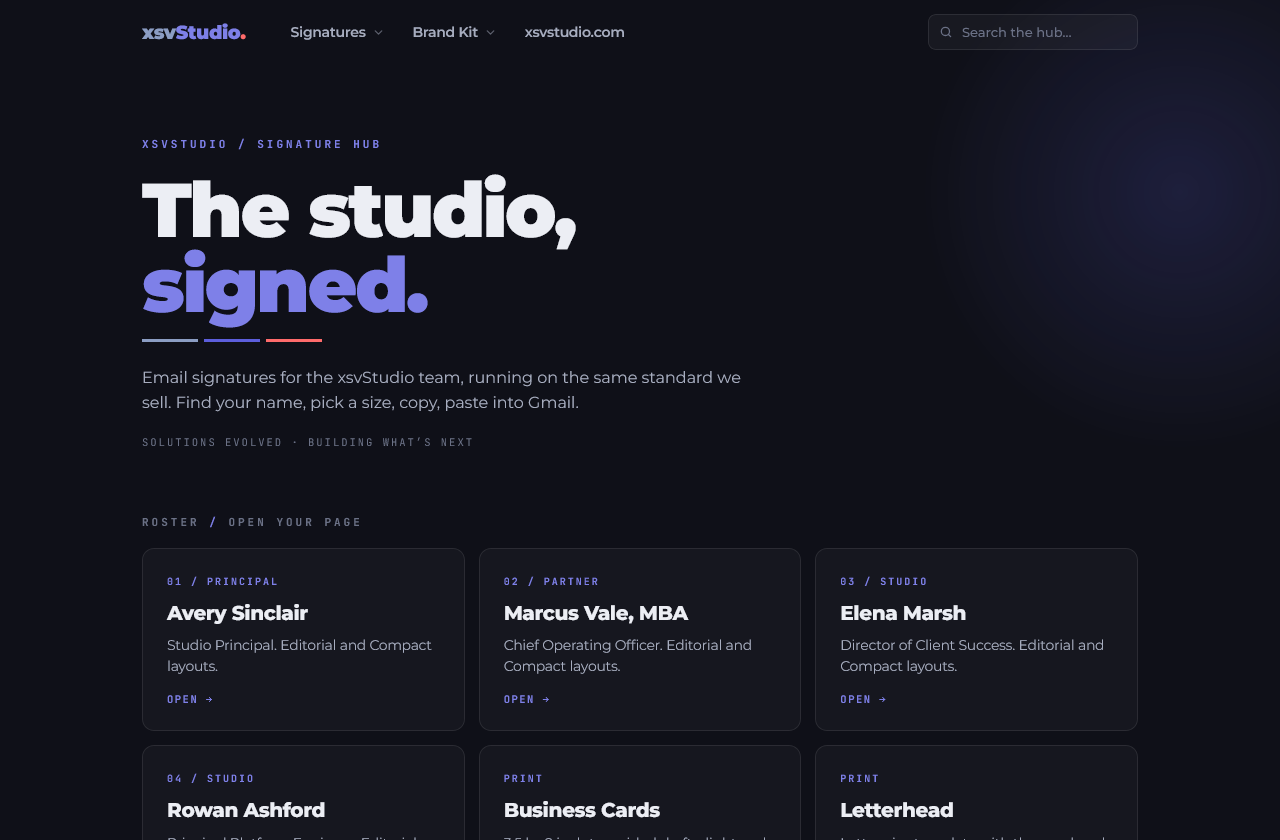
Signatures, the hub, print, and brand files, generated from one roster so a title change on Monday is everywhere by Tuesday. The screens below are our hubs as they run today, not mockups.
A brand panel and a live contact field in one table. It renders level in Outlook Classic, comes through Gmail’s rewrite on send, holds its color in dark mode, and scales whole on a phone. This is a person page in our own hub: find your name, press copy, paste.
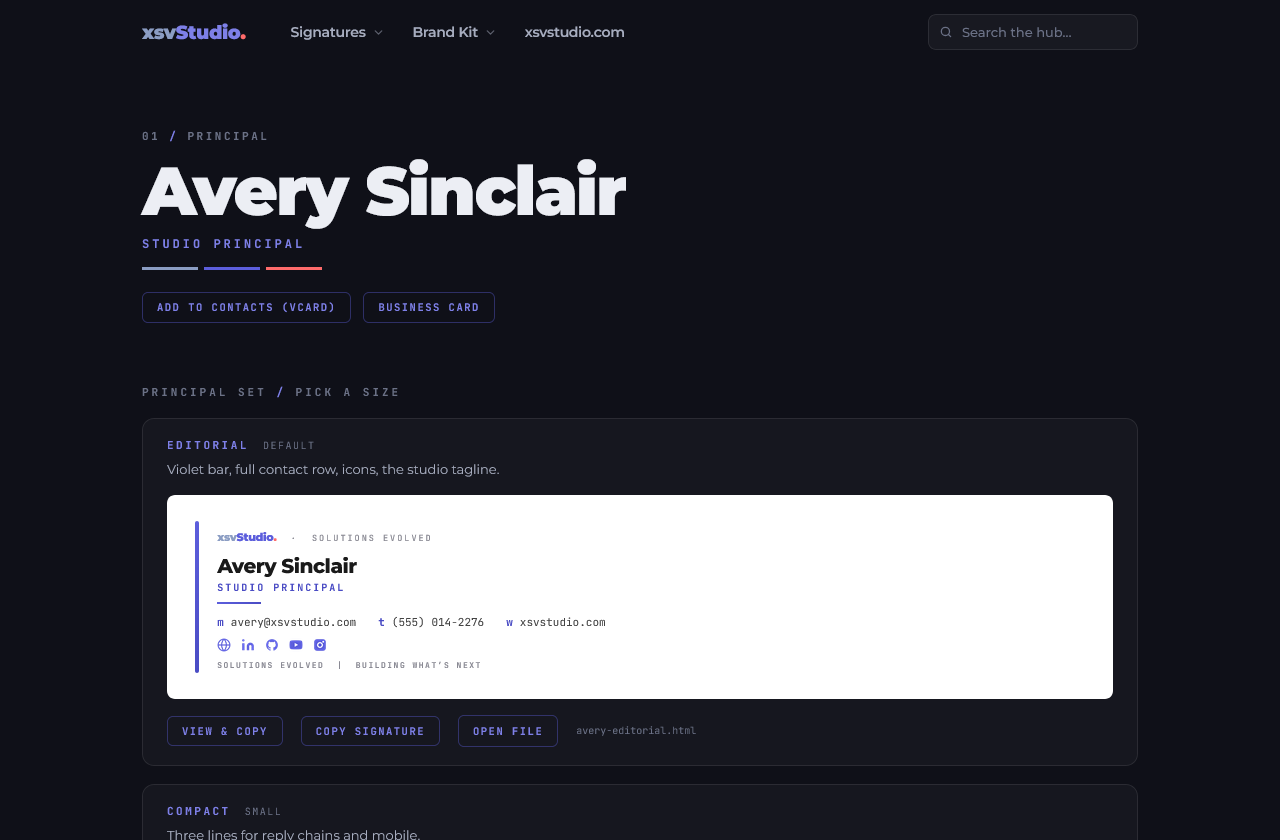
Every kit ships with a private hub in the client’s own brand: search the roster, preview every card, download any asset, read the standards. This is the xsvStudio hub, the one our own team uses.
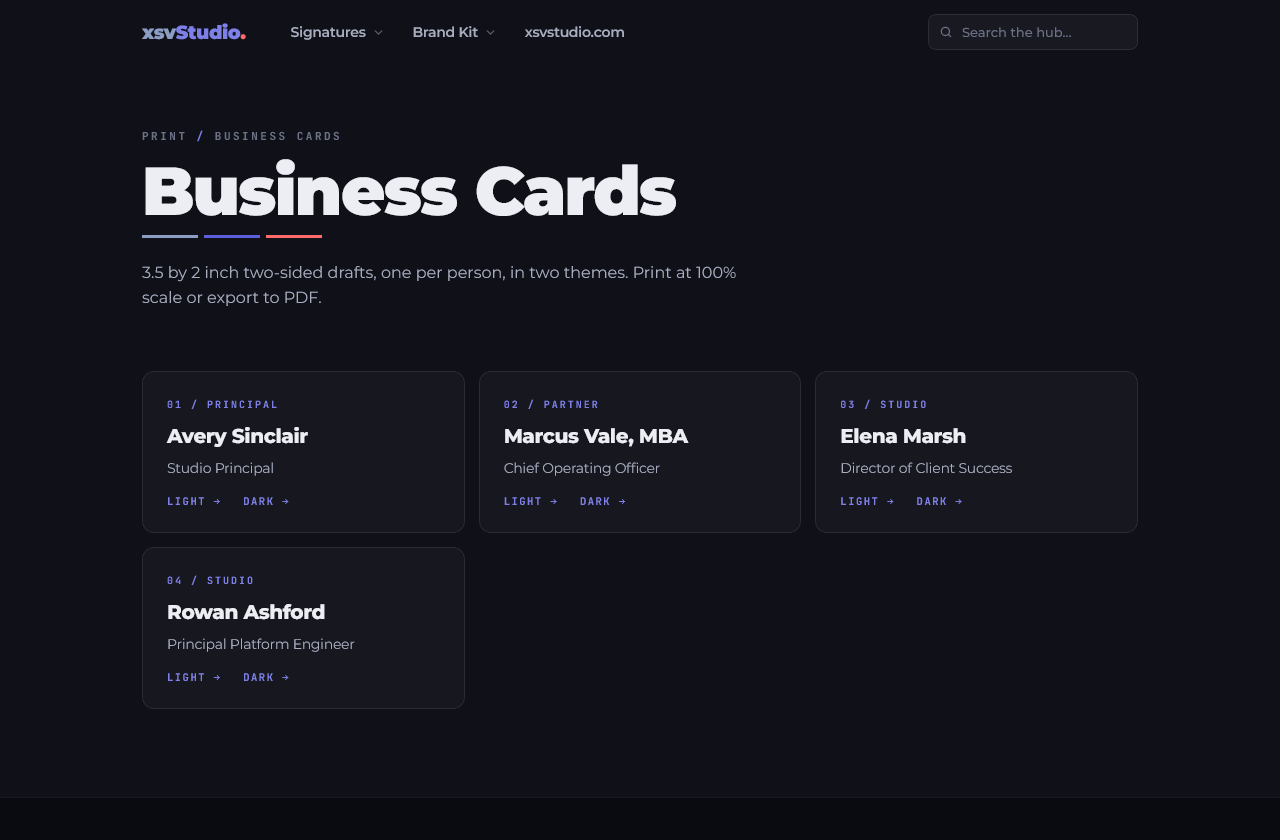
Print-ready letterhead and two-sided business card drafts, light and dark, generated from the same roster as the signatures. This cards page is live in our hub today.
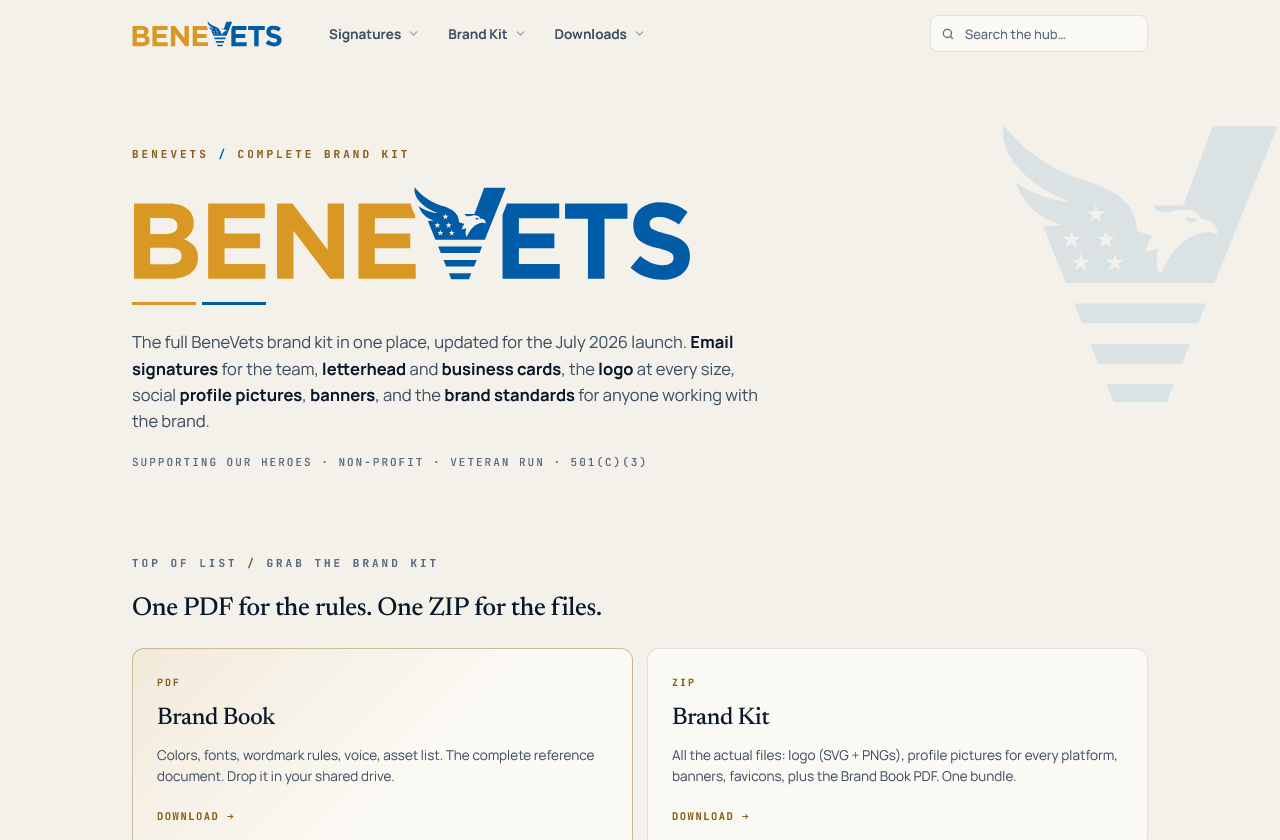
Logo lockups as vectors and rasters, profile images and banners sized per platform, favicons, and a brand book PDF that carries the rules. One ZIP for when someone asks for the logo. Shown here: the BeneVets kit, shipped for their July 2026 launch.
A software studio, a veterans nonprofit, a media agency, and two concept cuts. Same pipeline, looks that could not be mistaken for each other. Each screenshot is a hub this pipeline built.
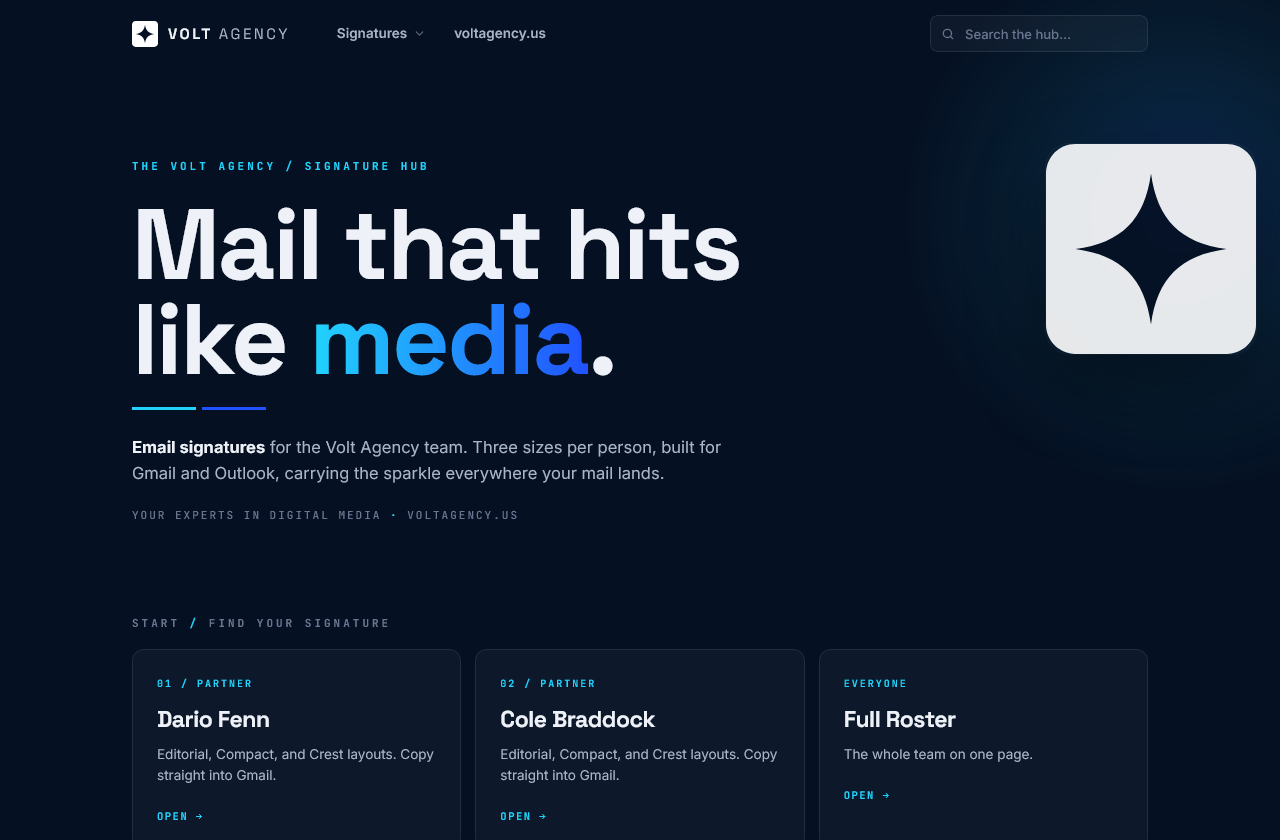
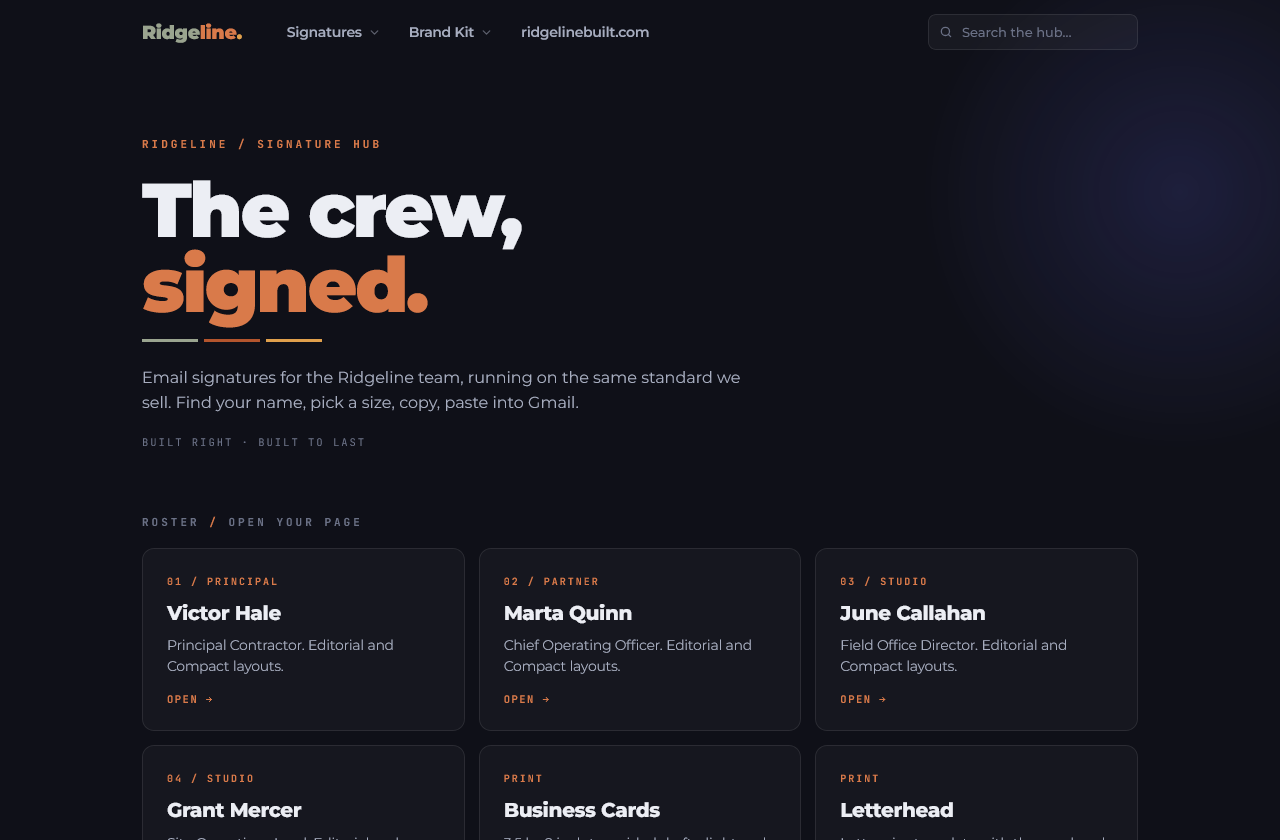
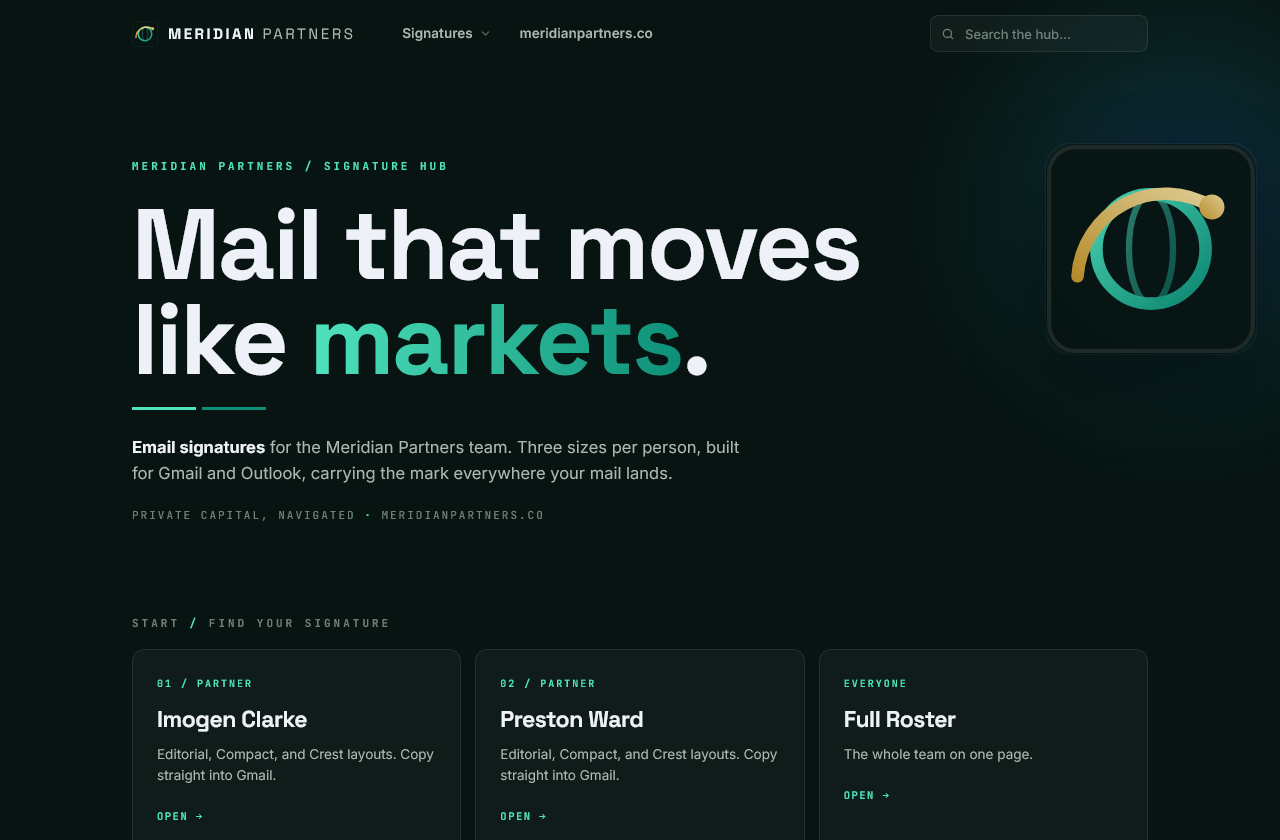
Rosters shown with stand-in names; one client shown under a stand-in brand.
A signature is the most-sent piece of your brand, and email is the most hostile place it lives. xBrand exists so it arrives intact.
Names and titles live in one roster. Change a title on Monday and it is in every signature by Tuesday, without chasing twelve people through twelve inboxes.
Panels and icons load from our servers, not from inside the email. No broken squares, no fuzzy attachments. Hosted files are never overwritten, so mail sent last year still renders today.
Gmail and Outlook rewrite what you paste. We build with the parts they leave alone: tables, safe fonts, hosted images, no backgrounds on live text. What your team pastes is what the client sees.
Tell us who you are and what you send. We reply from a human inbox, usually the same day.